Showing posts with label Nigeria. Show all posts

Tuesday, 20 December 2011

Sozaboy: A Novel in Rotten English | Ken Saro-Wiwa

9780582236998.jpg (260×400)

Review

‘This is both a novel of self-discovery and an indictment of a corrupt and muddled war – a kind of sombre picaresque lifted by the vivacity of its language’
Helen Birch, City Limits

William Boyd, who has written the introduction to Sozaboy, has described the author as ‘an extraordinary man and an extraordinary writer.’

Book Description

Sozaboy describes the fortunes of a young naive recruit in the Nigerian Civil War: from the first proud days of recruitment to the disillusionment, confusion and horror that follows. The author's use of 'rotten English' - a mixture of Nigerian pidgin English, broken English and idiomatic English - makes this a unique and powerful novel.

About the Author

1_wiwa.jpg (350×726)

Ken Saro-Wiwa, nominated for the Nobel Peace Prize in 1996, was a novelist, publisher, journalist and human rights activist. He was a committed and tireless campaigner on human rights and environmental issues. In November 1995 he was executed by the Nigerian authorities.

The Famished Road | Ben Okri

famished.jpg (500×500)

You have never read a novel like this one. Winner of the 1991 Booker Prize for fiction, The Famished Road tells the story of Azaro, a spirit-child. Though spirit-children rarely stay long in the painful world of the living, when Azaro is born he chooses to fight death: "I wanted", he says, "to make happy the bruised face of the woman who would become my mother." Survival in his chaotic African village is a struggle, though. Azaro and his family must contend with hunger, disease and violence, as well as the boy's spirit- companions, who are constantly trying to trick him back into their world. Okri fills his tale with unforgettable images and characters: the bereaved policeman and his wife, who try to adopt Azaro and dress him in their dead son's clothes; the photographer who documents life in the village and displays his pictures in a cabinet by the roadside; Madame Koto, "plump as a mighty fruit", who runs the local bar; the King of the Road, who gets hungrier the more he eats.
At the heart of this hypnotic novel are the mysteries of love and human survival. "It is more difficult to love than to die", says Azaro's father, and indeed, it is love that brings real sharpness to suffering here. As the story moves toward its climax, Azaro must face the consequences of choosing to live, of choosing to walk the road of hunger rather than return to the benign land of spirits. The Famished Road is worth reading for its last line alone, which must be one of the most devastating endings in contemporary literature (but don't skip ahead). -- R. Ellis

Review

"A brilliant read, unlike anything you have ever read before...the message is universal." -- Philip Howard, "The Times"
"Okri is incapable of writing a boring sentence. As one startling image follows the next, The Famished Road begins to read like an epic poem that happens to touch down just this side of prose.... When I finished the book and went outside, it was as if all the trees of South London had angels sitting in them." -- Linda Grant, "Independent on Sunday"
"It is a rich, provocative and hopeful vision of the world, stuffed full of drama and surprise.... Its literary lineage -- the ease with which spirits move through everyday life -- is from ancient Greece and medieval romances." -- Robert Winder, "Independent"
"Overwhelming...just buy it for its beauty." -- Jenny Turner, "New Statesman & Society"

Linda Grant, Independent on Sunday

‘When I finished the book and went outside, it was as if all the trees of South London had angels sitting in them’

Robert Winder, Independent

‘It is a rich, provocative and hopeful vision of the world, stuffed full of drama and surprise…'

Jenny Turner, New Statesman & Society

‘Overwhelming…just buy it for its beauty’

Book Description

Winner of the 1991 Booker Prize and the first book in Okri's acclaimed trilogy

Product Description

Azaro is a spirit child who is born only to live for a short while before returning to the idyllic world of his spirit companions. Now he has chosen to stay in the world of the living. This is his story. (20021018)

From the Publisher

Winner of the 1991 Booker Prize.

From the Back Cover

'A dazzling achievement for any writer in any language' New York Times Book Review

'A rich, provocative and hopeful vision of the world, stuffed full of drama and surprise' Independent

Azaro is a spirit child who is born only to live for a short while before returning to the idyllic world of his spirit companions. Now he has chosen to stay in the world of the living. This is his story.


'A brilliant read...unlike anything you have ever read before...the message is universal' The Times

Okri is incapable of writing a boring sentence... When I finished the book and went outside, it was as if all the trees of South London has angels sitting in them' Independent on Sunday

'A masterly portrait' Guardian

'Overwhelming...just buy it for its beauty' New Statesman

Also by Ben Okri in The Famished Road trilogy: [jpegs of Songs and Infinite Riches]

About the Author

Ben Okri's books have won several awards including the Commonwealth Writers' Prize for Africa, the Paris Review Aga Khan Prize for Fiction and the prestigious International Literary Prize Chianti Rufino-Antico Fattore 1993. The Famished Road won the Booker Prize in 1991. He was born in Minna, Nigeria. 

No Longer at Ease | Chinua Achebe

nolonger_at_ease.jpg (600×600)


Obi Okonkwo is an idealistic young man who, thanks to the privileges of an education in Britain, has now returned to Nigeria for a job in the civil service. However in his new role he finds that the way of government seems to be backhanders and corruption. Obi manages to resist the bribes that are offered to him, but when he falls in love with an unsuitable girl - to the disapproval of his parents - he sinks further into emotional and financial turmoil. The lure of easy money becomes harder to refuse, and Obi becomes caught in a trap he cannot escape.
Showing a man lost in cultural limbo, and a Nigeria entering a new age of disillusionment, No Longer at Ease concludes Achebe's remarkable trilogy charting three generations of an African community under the impact of colonialism, the first two volumes of which are Things Fall Apart and Arrow of God.

Plot Summary
The novel opens with the trial of Obi Okonkwo on a charge of accepting a bride. It then jumps back in time to a point before his departure for England and works its way forward to describe how Obi ended up on trial.
The members of the Umuofia Progressive Union (UPU), a group of Igbo men who have left their villages to live in major Nigerian cities, have taken up a collection to send Obi to England to study law, in the hope that he will return to help his people navigate English colonial society. But once there, Obi switches his major to English and meets Clara Okeke for the first time during a dance.
Obi returns to Nigeria after four years of studies and lives in Lagos with his friend Joseph. He takes a job with the Scholarship Board and is almost immediately offered a bribe by a man who is trying to obtain a scholarship for his little sister. When Obi indignantly rejects the offer, he is visited by the girl herself who implies that she will bribe him with sexual favors for the scholarship, another offer Obi rejects.
At the same time, Obi is developing a romantic relationship with Clara Okeke, a Nigerian girl who eventually reveals that she is an osu, an outcast by her descendants, meaning that Obi can not marry her under the traditional ways of the Igbo people of Nigeria. While he remains intent on marrying Clara, even his Christian  father opposes it, although reluctantly due to his desire to progress and eschew the "heathen" customs of pre-colonial Nigeria. His mother begs him on her deathbed not to marry Clara until after her death, threatening to kill herself if Obi disobeys. When Obi informs Clara of these events, Clara breaks the engagement and intimates that she is pregnant. Obi arranges an abortion, which Clara reluctantly undergoes, but she suffers complications and refuses to see Obi afterwards.
All the while, Obi sinks deeper into financial trouble, in part due to poor planning on his end, in part due to the need to repay his loan to the UPU and to pay for his siblings' educations, and in part due to the cost of the illegal abortion.
After hearing of his mother's death, Obi sinks into a deep depression, and refuses to go home for the funeral. When he recovers, he begins to accept bribes in a reluctant acknowledgement that it is the way of his world.
The novel closes as Obi takes a bribe and tells himself that it is the last one he will take, only to discover that the bribe was part of a sting operation. He is arrested, bringing us up to the events that opened the story

About the Author


Chinua+Achebe+9.jpg (333×500)

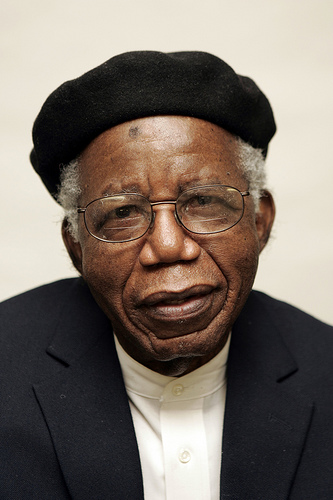
  • Chinua Achebe was born in Nigeria in 1930. He was raised in the large village of Ogidi, one of the first centers of Anglican missionary work in Eastern Nigeria, and is a graduate of University College, Ibadan. His early career in radio ended abruptly in 1966, when he left his post as Director of External Broadcasting in Nigeria during the national upheaval that led to the Biafran War. Achebe joined the Biafran Ministry of Information and represented Biafra on various diplomatic and fund-raising missions. He was appointed Senior Research Fellow at the University of Nigeria, Nsukka, and began lecturing widely abroad. For over fifteen years, he was the Charles P. Stevenson Professor of Languages and Literature at Bard College. He is now the David and Marianna Fisher University Professor and professor of Africana studies at Brown University. Chinua Achebe has written over twenty books - novels, short stories, essays and collections of poetry - and has received numerous honours from around the world, including the Honourary Fellowship of the American Academy of Arts and Letters, as well as honourary doctorates from more than thirty colleges and universities. He is also the recipient of Nigeria's highest award for intellectual achievement, the Nigerian National Merit Award. In 2007, he won the Man Booker International Prize for Fiction.

  • Book Details
  • Paperback: 144 pages
  • Publisher: Penguin Classics (28 Jan 2010)
  • Language English
  • ISBN-10: 0141191554
  • ISBN-13: 978-0141191553
  • Product Dimensions: 19.4 x 12.6 x 1.4 cm

Arrow of God | Chinua Achebe

9780141191560.jpg (260×400)


Review


Ezeulu, headstrong chief priest of the god Ulu, is worshipped by the six villages of Umuaro. But he is beginning to find his authority increasingly under threat - from his rivals in the tribe, from those in the white government and even from his own family. Yet he still feels he must be untouchable - surely he is an arrow in the bow of his God? Armed with this belief, he is prepared to lead his people, even if it means destruction and annihilation. Yet the people will not be so easily dominated.

Spare and powerful, Arrow of God is an unforgettable portrayal of the loss of faith, and the struggle between tradition and change. Continuing the epic saga of the community in Things Fall Apart, it is the second volume of Achebe's African trilogy, and is followed by No Longer at Ease.

About the Author


Chinua-Achebe-006.jpg (690×414)


Chinua Achebe was born in Nigeria in 1930. He was raised in the large village of Ogidi, one of the first centers of Anglican missionary work in Eastern Nigeria, and is a graduate of University College, Ibadan. His early career in radio ended abruptly in 1966, when he left his post as Director of External Broadcasting in Nigeria during the national upheaval that led to the Biafran War. Achebe joined the Biafran Ministry of Information and represented Biafra on various diplomatic and fund-raising missions. He was appointed Senior Research Fellow at the University of Nigeria, Nsukka, and began lecturing widely abroad. For over fifteen years, he was the Charles P. Stevenson Professor of Languages and Literature at Bard College. He is now the David and Marianna Fisher University Professor and professor of Africana studies at Brown University. Chinua Achebe has written over twenty books - novels, short stories, essays and collections of poetry - and has received numerous honours from around the world, including the Honourary Fellowship of the American Academy of Arts and Letters, as well as honourary doctorates from more than thirty colleges and universities. He is also the recipient of Nigeria's highest award for intellectual achievement, the Nigerian National Merit Award. In 2007, he won the Man Booker International Prize for Fiction.


  • Book Details:
  • Paperback: 240 pages
  • Publisher: Penguin Classics (28 Jan 2010)
  • Language English
  • ISBN-10: 0141191562
  • ISBN-13: 978-0141191560
  • Product Dimensions: 19.6 x 12.8 x 2.2 cm

Half of a Yellow Sun | Chimamanda Ngozi Adichie

half-of-a-yellow-sun.jpg (311×475)


Review

`The first great African novel of the new century' Alison Lurie
--Guardian Books of the Decade, 2007

Independent

'This magnificent novel is a gripping portrayal of the horrors of
war...A major new African voice.'

The Times

'a powerfully convincing account of one of the bloodier episodes
of post-colonial history.'

Daily Mail

'...funny, heartbreaking, exquisitely written and, without doubt, a literary masterpiece and a classic.' --This text refers to an out of print or unavailable edition of this title.

Independent

'A magnificent novel.' --This text refers to an out of print or unavailable edition of this title.

Guardian

'Adichie is part of a new generation revisiting the history that her parents survived...' --This text refers to an out of print or unavailable edition of this title.

The Works Magazine

'Full of drama and characters you care about, this is an educational and enlightening read.' --This text refers to an out of print or unavailable edition of this title.

The Times

'Adichie uses language with relish. Adichie's English is infused with rich poetry.' --This text refers to an out of print or unavailable edition of this title.

Telegraph

'What a travesty that Half of a Yellow Sun is not in contention for the Booker prize this year.' --This text refers to an out of print or unavailable edition of this title.

Sunday Times

'The novel sustains the interest with its engaging characters and its mostly artful simplicity of style.' --This text refers to an out of print or unavailable edition of this title.

Product Description

Winner of the Orange Broadband Prize for Fiction 2007, this is a heartbreaking, exquisitely written literary masterpiece. This highly anticipated novel from Chimamanda Ngozi Adichie is set in Nigeria during the 1960s, at the time of a vicious civil war in which a million people died and thousands were massacred in cold blood. The three main characters in the novel are swept up in the violence during these turbulent years. One is a young boy from a poor village who is employed at a university lecturer's house. The other is a young middle-class woman, Olanna, who has to confront the reality of the massacre of her relatives. And the third is a white man, a writer who lives in Nigeria for no clear reason, and who falls in love with Olanna's twin sister, a remote and enigmatic character. As these people's lives intersect, they have to question their own responses to the unfolding political events. This extraordinary novel is about Africa in a wider sense: about moral responsibility, about the end of colonialism, about ethnic allegiances, about class and race; and about the ways in which love can complicate all of these things.

From the Publisher

The Stories of Africa: a Q & A with Chimamanda Ngozi Adichi
Q: What led you to write a book about the Nigeria-Biafra war?
I wrote this novel because I wanted to write about love and war, because I
grew up in the shadow of Biafra, because I lost both grandfathers in the
Nigeria-Biafra war, because I wanted to engage with my history in order to
make sense of my present, because many of the issues that led to the war
remain unresolved in Nigeria today, because my father has tears in his eyes
when he speaks of losing his father, because my mother still cannot speak
at length about losing her father in a refugee camp, because the brutal
bequests of colonialism make me angry, because the thought of the egos and
indifference of men leading to the unnecessary deaths of men and women and
children enrages me, because I don't ever want to forget. I have always
known that I would write a novel about Biafra. At 16, I wrote an awfully
melodramatic play called For Love of Biafra. Years later, I wrote short
stories, That Harmattan Morning, Half of a Yellow Sun and Ghosts, all
dealing with the war. I felt that I had to approach the subject with little
steps, paint on a smaller canvas first, before starting the novel.
Q: Given that at the time of the war you hadn't yet been born, what sort of
research did you do to prepare for writing this book?
I read books. I looked at photos. I talked to people. In the four years
that it took to finish the book, I would often ask older people I met,
`Where were you in 1967?' and then take it from there. It was from stories
of that sort that I found out tiny details that are important for fiction.
My parents' stories formed the backbone of my research. Still, I have a lot
of research notes that I did not end up using because I did not want to be
stifled by fact, did not want the political events to overwhelm the human
story.
Q: Are memories of the Nigeria-Biafra war still alive in Nigeria, talked
about on a regular basis, or do you feel that the conflict is being lost to
history as time passes and that it becomes less important to Igbo culture?
The war is still talked about, still a potent political issue. But I find
that it is mostly talked about in uninformed and unimaginative ways. People
repeat the same things they have been told without having a full grasp of
the complex nature of the war or they hold militant positions lacking in
nuance. It also remains, to my surprise, very ethnically divisive: the
(brave enough) Igbo talk about it and the non-Igbo think the Igbo should
get over it. There is a new movement called MASSOB, the Movement for the
Actualization of the Sovereign State of Biafra, which in the past few years
has captured the imagination of many Igbo people. MASSOB is controversial;
it is reported to engage in violence and its leaders are routinely arrested
and harassed by the government. Still, despite its inchoate objectives,
MASSOB's grassroots support continues to grow. I think this is because it
gives a voice to many issues that have been officially swept aside by the
country but which continue to resonate for many Igbo people.
Q: The book focuses on the experiences of a small set of people who are
experiencing the conflict from very different points of view. When we step
into their individual worlds, we don't know their every thought - the
narrator who follows them isn't omniscient - but rather we seem to see and
understand them through a film. Can you describe your narrative style and
why you framed these characters the way you did?
I actually don't think of them as being seen through a `film'. I have
always been suspicious of the omniscient narrative. It has never appealed
to me, always seemed a little lazy and a little too easy. In an
introduction to the brilliant Italian writer Giovanni Verga's novel, it is
said about his treatment of his characters that he `never lets them analyze
their impulses but simply lets them be driven by them'. I wanted to write
characters who are driven by impulses that they may not always be
consciously aware of, which I think is true for us human beings. Besides, I
didn't want to bore my reader - and myself - to death, exploring the
characters' every thought.
Q: The character Richard is a British white expatriate who considers
himself Biafran, drawing a certain amount of quiet- and some loud-
criticism for his self-proclaimed identity. Another key narrator, Ugwu, is
a 13-year-old houseboy who reacts rather than acts. Both are interesting
choices for characters for the narrator to `shadow'. Why did you pick
them?
Ugwu was inspired in part by Mellitus, who was my parents' houseboy during
the war; in part by Fide, who was our houseboy when I was growing up. And I
have always been interested in the less obvious narrators. When my mom
spoke about Mellitus, what a blessing he was, how much he helped her, how
she did not know what she would have done without him, I remember being
moved but also thinking that he could not possibly have been the saint my
mother painted, that he must have been flawed and human. I think that Ugwu
does come to act more and react less as we watch him come into his own.
Richard was a more difficult choice. I very much wanted somebody to be the
Biafran `outsider' because I think that outsiders played a major role in
the war but I wanted him, also, to be human and real - and needy!

From the Author

In the Shadow of Biafra
by Chimamanda Ngozi Adichie

I taught an introductory creative writing class at Princeton last year and,
in addition to the classic `show don't tell', I often told my students that
their fiction needed to have `emotional truth'. I am not sure whether they
knew exactly what `emotional truth' meant. Sometimes I was not sure that I
did either, or perhaps it was simply that I could never fully define it. I
could, however, recognize it whenever I saw it: a quality different from
honesty and more resilient than fact, a quality that existed not in the
kind of fiction that explains but in the kind of fiction that shows. All
the novels I love, the ones I remember, the ones I re-read, have this
empathetic human quality. And because I write the kind of fiction I like to
read, when I started Half of a Yellow Sun, set before and during the
Nigeria-Biafra war of 1967-1970, I hoped that emotional truth would be its
major recognizable trait.
I hoped, too, that it would be the kind of character-driven war novel brave
enough to engage subtly with politics, as the Zimbabwean writer Shimmer
Chinodya does in his remarkable Harvest of Thorns. What struck me most
about Harvest of Thorns was that I emerged from it with a complex portrait
of Zimbabwe's war of independence from - at last - the point of view of
black Zimbabweans without ever feeling as if I had been lectured. The
wonderfully restrained sense of deep disappointment underlying Chinodya's
narrative reminded me of how similar the histories of many African
countries are, how passionately people believed in ideas that would
eventually disappoint them, in people that would betray them, in futures
that would elude them. The Biafra stories in Chinua Achebe's Girls at War
and Other Stories are also about what happens when the shiny things we once
believed in begin to rust before our eyes. Achebe's trademark compassionate
irony - he respects his characters but at the same time is amused by them
and expects the reader to be also - is not very obvious in Sugar Baby,
which is the best piece of fiction I have read about Biafra. It starts with
the narrator watching his friend Cletus fling a handful of sugar out of the
window. A symbolic act: Cletus is an unqualified sweet tooth (something he
must have developed as a student living in Ladbroke Grove) and the
unbearable sugar scarcity in Biafra led to humiliations, one involving the
loss of his girlfriend, another the rage of an Irish priest. Now that the
war is over, Cletus and his friends are eager to tell self-flagellating
stories of hardship, they `had become in those days like a bunch of old
hypochondriac women vying to recount the most lurid details of their own
special infirmities.' The narrator is reluctant to join in. For him, there
is something still too painful, too sacred, about their recent history; he
is not yet ready to laugh at the once-shiny rusted things.
Girls at War portrays a world inhabited by people who feel their
metaphysical losses more strongly than their material ones. Their
disillusion, their manic self-mockery, their fixation on survival, are all
corollaries of their deep faith in their cause. Achebe's war fiction then,
humane and pragmatic as it is, becomes an oblique paean to the
possibilities that Biafra held. The stories have an emotional power that
accumulate in an unobtrusive way and stun the reader at the end; there are
sentences in them that will always move me to tears.
Successful fiction does not need to be validated by `real life'; I cringe
whenever a writer is asked how much of a novel is `real'. Yet, I find
myself thinking differently about these two war novels I admire. I have
often wondered how much of the character Benjamin in Harvest of Thorns
mirrors Shimmer Chinodya, how much of the muted defeat in Girls at War is
in fact what Chinua Achebe himself felt about the loss of Biafra. Perhaps
it is because to write realistic fiction about a war, especially one
central to the history of one's country, is to be constantly aware of a
responsibility to something larger than art. While writing Half of a Yellow
Sun, I enjoyed playing with minor things: inventing a train station in a
town that has none, placing towns closer to each other than they are,
changing the chronology of conquered towns. Yet I did not play with the
central events of that time. I could not let a character be changed by
anything that had not actually happened. If fiction is indeed the soul of
history, then I was equally committed to the fiction and the history,
equally keen to be true to the spirit of the time as well as to my artistic
vision of it.
The writing itself was a bruising experience. I struggled to maintain many
fragile balances. I cried often, was frequently crippled with doubt and
anxiety, often wondered whether to stop or to scale back. But there were
also moments of extravagant joy when I recognized, in a character or moment
or scene, that quality of emotional truth. 

About the Author

Chimamanda Ngozi Adichie was born in Nigeria in 1977. She is from Abba, in Anambra State, but grew up in the university town of Nsukka, where she attended primary and secondary schools. She went on to receive a BS in Communication and Political Science from Eastern Connecticut State University and an MA from Johns Hopkins University, both in the United States. Her short fiction has been published in literary journals including Granta, and won the International PEN/David Wong award in 2003. 'Purple Hibiscus', her first novel, was shortlisted for the Orange Prize and the John Llewellyn Rhys Prize and was winner of the Hurston/Wright Legacy award for debut fiction. She was a Hodder fellow at Princeton University for the 2005-2006 academic year. She lives in Nigeria.

Purple Hibiscus | Chimamanda Ngozi Adichie

purplehibiscus.jpg (312×475)


Review

'A beautiful and often harrowing story.' Observer Books of the Year 'A sensitive and touching story of a child exposed too early to religious intolerance and the uglier side of the Nigerian state.' J. M. Coetzee 'Political brutality and domestic violence, religion and witchcraft all merge with subtle force in this memorable novel. Chimammanda Ngozi Adichie uses childhood innocence to write Nigerian history with the eye of a family insider.' Hugo Hamilton 'Purple Hibiscus is the best debut I've read since Arundhati Roy's The God of Small Things.' Jason Cowley, Times journalist, literary editor of the New Statesman 'This debut ensnares the reader from the first page and lingers in the memory!in soft, searing voice, Adichie examines the complexities of family, faith and country through the haunted but hopeful eyes of a young girl on the cusp of womanhood.' Publishers Weekly

Guardian

`Adjoa Andoh's characterisation of the narrator, whose confused love/hate relationship with her father underpins the story, is stunning.' --This text refers to the Hardcover edition.

The Times

'It's a mature coming-of-age story, and an engrossing portrait of Nigerian society.' --This text refers to an out of print or unavailable edition of this title.

Sunday Times

`Adjoa Andoh's ear for the characterful eccentricities of Nigerian speech gives the beautifully described contemporary African world a lively pulse' 

--This text refers to the Hardcover edition.

Product Description

Longlisted for the 2004 Man Booker Prize Shortlisted for the 2004 Orange Prize A haunting tale of an Africa and an adolescence undergoing tremendous changes by a talented young Nigerian writer. The limits of fifteen-year-old Kambili's world are defined by the high walls of her family estate and the dictates of her repressive and fanatically religious father. Her life is regulated by schedules: prayer, sleep, study, and more prayer. When Nigeria begins to fall apart during a military coup, Kambili's father, involved mysteriously in the political crisis, sends Kambili and her brother away to live with their aunt. In this house, full of energy and laughter, she discovers life and love -- and a terrible, bruising secret deep within her family. Centring on the promise of freedom and the pain and exhilaration of adolescence, Purple Hibiscus is the extraordinary debut of a remarkable new talent.

About the Author

Image of Chimamanda Ngozi Adichie
Author | Chimamanda Ngozi Adichie
Chimamanda Ngozi Adichie was born in Nigeria in 1977. Her first novel 'Purple Hibiscus' was published in 2003 and was longlisted for the Booker Prize. Her second novel 'Half of a Yellow Sun' won the 2007 Orange Prize for Fiction. Her work has been selected by the Commonwealth Broadcasting Association and the BBC Short Story Awards and has appeared in various literary publications, including Zoetrope and The Iowa Review.


  • Book Details
  • Paperback: 336 pages
  • Publisher: Harper Perennial; New Ed edition (7 Feb 2005)
  • Language English
  • ISBN-10: 0007189885
  • ISBN-13: 978-0007189885
  • Product Dimensions: 19.4 x 12.8 x 2.4 cm

Delta Nigeria - The Rape of Paradise | George Osodi

Delta Nigeria: The Rape of Paradise


For more than five centuries the fortunes of the Niger Delta have been closely tied to that of the global economy. For its slave ports, then palm oil industry, and most recently, through the discovery of crude oil in the 1950s. Oil multinationals soon came to the fore, working in alliance with a local elite to strip the region of its wealth and despoil it. At the receiving end are the region's impoverished inhabitants: left with a poisoned environment, faced with a government that never cares and victims of rival armed militant groups laying claim to territories. George Osodi is an internationally acclaimed Nigerian photographer, who has spent over six years documenting his country, hoping to bring attention to not only the rest of the world, but the people of Nigeria, what is happening. A country still so rich in natural resources and beauty, but where many of its people have been left with nothing.


About the Photographer


George Osodi at galerie-herrmann.com in Germany


George Osodi is a Nigerian photographer from Lagos. His photographs range between photojournalism and artistic documentary, closely observing social, economic and ecological processes of exploitation. He was chosen to be part of the prestigious Documenta art fair in 2007.


Book Details:

  • Hardcover: 248 pages
  • Publisher: Trolley; illustrated edition edition (31 Oct 2011)
  • Language English
  • ISBN-10: 1904563856
  • ISBN-13: 978-1904563853
  • Product Dimensions: 26 x 20 x 2.8 cm

Here is a Youtube slideshow of George Osodi's work:


Sunday, 27 November 2011

The Granta Book of the African Short Story by Helon Habila


Review

A timely anthology of short stories [that] reveals the strength of contemporary African fiction. Ruth FranklinProspect (01/09/11)
Granta’s continuing energy and brio make it shine among publishers. Many of the writers deserve an audience beyond their national boundaries; Granta has manoeuvred itself into a unique position where it is the only publisher which not only can do this, but do it fantastically well. Helon Habila has made a good fist of an almost impossible task. The overall feel of this collection is big, brave and intricately interwoven … There is a clutch of terrific stories here for almost every kind of reader. Chris DolanHerald (03/09/11)
The majority of authors in the collection are lively and innovative and paint a good picture of emerging African talent … Granta’s new collection shows a generation of engaging and talented writers coming out of Africa. Habila suggests that with the spread of the internet across the continent in the past fifteen years, short fiction has found a new outlet for publication and will continue to gain exposure across the globe where previously it would never have done. Things can only get better, Habila hints, although to be honest they were pretty good to start with. Tom LittleThink Africa Press (06/09/11)
The skill and sophistication of African authors is on display throughout this rich and rewarding book.
Joan SmithThe Times (10/09/11)
Brings together some of the most exciting voices from this generation of Afropolitans. Ellah Allfrey, Daily Telegraph Review (10/09/11)
A sense of often painful transition echoes through these  snapshots; as does a defiance in the face of all that can be thrown at these modern Africans.  Siobhan MurphyMetroBook of the Week (15/09/11)

Product Description

The Granta Book of the African Short Story introduces a group of African writers described by its editor, Helon Habila, as ‘the post-nationalist generation’. Presenting a diverse and dazzling collection from all over the continent - from Morocco to Zimbabwe, Uganda to Kenya - Habila has focused on younger, newer writers, interspersed with some of their older, more established peers, to give a fascinating picture of a new and more liberated Africa.Disdaining the narrowly nationalist and political preoccupations of previous generations, these writers are characterized by their engagement with the wider world and the opportunities offered by the internet, the end of apartheid, the end of civil wars and dictatorships, and the possibilities of free movement around the world. Many of them live outside Africa. Their work is inspired by travel and exile. They are liberated, global and expansive. As Dambudzo Marechera wrote: "If you write for a particular nation, or tribe, then f*** you." These are the stories of a new Africa, punchy, self-confident and defiant.Includes stories by: Rachida El Charni; Henrietta Rose-Innes; George Makana Clarke; Ivan Vladislavik; Mansoura Ez Eldin; Fatou Diome; Aminatta Forna; Manuel Rui; Patrice Nganang; Leila Aboulela; Zoe Wicombe; Ala Al-Aswany; Doreen Baingana; EC Osonduq

Book Description

The Granta Book of the African Short Story introduces a group of African writers described by its editor, Helon Habila, as 'the post-nationalist generation'. Presenting a diverse and dazzling collection from all over the continent - from Morocco to Zimbabwe, Uganda to Kenya - Habila has focused on younger, newer writers, contrasted with some of their older, more established peers, to give a fascinating picture of a new and more liberated Africa.
Disdaining the narrowly nationalist and political preoccupations of previous generations, these writers are characterized by their engagement with the wider world and the opportunities offered by the internet, the end of apartheid, the end of civil wars and dictatorships, and the possibilities of free movement around the world. Many of them live outside Africa. Their work is inspired by travel and exile. They are liberated, global and expansive. As Dambudzo Marechera wrote: 'If you're a writer for a specific nation or specific race, then f*** you." These are the stories of a new Africa, punchy, self-confident and defiant.
Includes stories by:
Rachida el-Charni; Henrietta Rose-Innes; George Makana Clark; Ivan Vladislavic; Mansoura Ez-Eldin; Fatou Diome; Aminatta Forna; Manuel Rui; Patrice Nganang; Leila Aboulela; Zoe Wicomb; Alaa Al Aswany; Doreen Baingana; E.C. Osondu

About the Author


Helon Habila was born in Nigeria. He has published three novels, Waiting for an Angel (2002), Measuring Time (2007) and Oil on Water (2010). Winner of the Caine Prize 2001, and the Commonwealth Writer's Prize 2003, Habila currently teaches Creative Writing at George Mason University in Fairfax, Virginia, where he lives with his family.

Tuesday, 2 August 2011

Chris Abani | Graceland

From Publishers Weekly

Abani's debut novel offers a searing chronicle of a young man's coming of age in Nigeria during the late 1970s and early 1980s. The vulnerable, wide-eyed protagonist is Elvis Oke, a young Nigerian with a penchant for dancing and impersonating the American rock-and-roll singer he is named after. The story alternates between Elvis's early years in the 1970s, when his mother dies of cancer and leaves him with a disapproving father, and his life as a teenager in the Lago ghetto, a place one character calls "a pus-ridden eyesore on de face of de nation's capital." Relating how an innocent child grows into a hardened young man, the novel also gives a glimpse into a world foreign to most readers-a brutal Third World country permeated by the excesses and wonders of American popular culture. Sprinkled throughout the book are recipes and entries from Elvis's mother's journal, as well as descriptions of the kola nut ceremony through which an Igbo boy becomes a man. These sections at first seem showy and tacked on, but by the end of the book their significance becomes clearer. The book is most powerful when it refrains from polemic and didacticism and simply follows its protagonist on his daily journey through the violent, harsh Nigerian landscape. Elvis must also negotiate troubles closer to home, including a drunk and ruined father and friends who cannot always be trusted. In this book, names are destiny, "selected with care by your family and given to you as a talisman." One of Elvis's friends is named Redemption, but in the end it is Elvis who claims this moniker, both literally and symbolically.
Copyright © Reed Business Information, a division of Reed Elsevier Inc. All rights reserved. --This text refers to an out of print or unavailable edition of this title.

From Booklist

Elvis Oke, a teenage Elvis impersonator in Lagos, Nigeria, attempts to come of age in spite of an alcoholic father who beats him and a soul-crushing ghetto environment that threatens to engulf him. Beset by floods, vermin, and the ubiquitous Colonel, chief of military security in Lagos, Elvis lives from day to day, saturated by a bizarrely out of date, misunderstood version of American pop culture and remembering his life in the country before his mother died and his father lost his career. Immigration to the U.S. is Elvis' dream, shared by his underworld friend, Redemption, although their notion of America comes mainly from untranslated, decades-old movies, all of which are interpreted only in terms of the conflict between John Wayne (all good guys) and Actor (everyone else). The novel offers a vibrant picture of an alien yet somehow parallel culture, and while the plot runs off the rails from time to time, the mix of surrealistic horror and cross-cultural humor is irresistible. Abani is a first novelist with a very bright future. Bill Ott
Copyright © American Library Association. All rights reserved --This text refers to an out of print or unavailable edition of this title.

Review

"Abani's intensely visual style--and his sense of humor--convert the stuff of hopelessness into the stuff of hope."--San Francisco Chronicle

"Extraordinary...This book works brilliantly in two ways. As a convincing and unpatronizing record of life in a poor Nigerian slum, and as a frighteningly honest insight into a world skewed by casual violence, it's wonderful...And for all the horrors, there are sweet scenes in Graceland too, and they're a thousand times better for being entirely unsentimental...Lovely." --The New York Times Book Review

"To say that this is a Nigerian or African novel is to miss the point. This absolutely beautiful work of fiction is about complex strained political structures, the irony of the West being a measure of civilization, and the tricky business of being a son. Abani's language is beautiful and his story is important."--Percival Everett

Book Description

"A richly detailed, poignant, and utterly fascinating look into another culture and how it is cross-pollinated by our own. It brings to mind the work of Ha Jin in its power and revelation of the new."--T. Coraghessan Boyle

The sprawling, swampy, cacophonous city of Lagos, Nigeria, provides the backdrop to the story of Elvis, a teenage Elvis impersonator hoping to make his way out of the ghetto. Nuanced, lyrical, and pitch perfect, this is a remarkable story of a son and his father, and an examination of postcolonial Nigeria, where the trappings of American culture reign supreme.

From the Back Cover

"A richly detailed, poignant, and utterly fascinating look into another culture and how it is cross-pollinated by our own. It brings to mind the work of Ha Jin in its power and revelation of the new."--T. Coraghessan Boyle

The sprawling, swampy, cacophonous city of Lagos, Nigeria, provides the backdrop to the story of Elvis, a teenage Elvis impersonator hoping to make his way out of the ghetto. Nuanced, lyrical, and pitch perfect, this is a remarkable story of a son and his father, and an examination of postcolonial Nigeria, where the trappings of American culture reign supreme.

"Abani's intensely visual style--and his sense of humor--convert the stuff of hopelessness into the stuff of hope."--San Francisco Chronicle

"Extraordinary...This book works brilliantly in two ways. As a convincing and unpatronizing record of life in a poor Nigerian slum, and as a frighteningly honest insight into a world skewed by casual violence, it's wonderful...And for all the horrors, there are sweet scenes in Graceland too, and they're a thousand times better for being entirely unsentimental...Lovely." --The New York Times Book Review

"To say that this is a Nigerian or African novel is to miss the point. This absolutely beautiful work of fiction is about complex strained political structures, the irony of the West being a measure of civilization, and the tricky business of being a son. Abani's language is beautiful and his story is important."--Percival Everett

Chris Abani was born in Nigeria. At age sixteen he published his first novel, for which he suffered severe political persecution. He went into exile in 1991, and has since lived in England and the United States. His last book, Daphne's Lot, is a collection of poetry for which he won a 2003 Lannan Literary Fellowship. He is also the recipient of the PEN USA West Freedom to Write Award and the Prince Claus Award. Abani lives and teaches in Los Angeles. 

About the Author

Chris Abani was born in Nigeria. At age sixteen he published his first novel, for which he suffered severe political persecution. He went into exile in 1991, and has since lived in England and the United States. His last book, Daphne's Lot, is a collection of poetry for which he won a 2003 Lannan Literary Fellowship. He is also the recipient of the PEN USA West Freedom to Write Award and the Prince Claus Award. Abani lives and teaches in Los Angeles. 

Excerpt. © Reprinted by permission. All rights reserved.

Excerpt from GraceLand by Chris Abani. Copyright © 2004 by Christopher Abani. To be published in February, 2004 by Farrar, Straus & Giroux, LLC. All rights reserved.


Book I

It seemed almost incidental that he was African.
So vast had his inner perceptions grown over the years . . .
—BESSIE HEAD,
A Question of Power


ONE

This is the kola nut. This seed is a star. This star is life. This star is us.

The lgbo hold the kola nut to be sacred, offering it at every gathering and to every visitor, as a blessing, as refreshment, or to seal a covenant. The prayer that precedes the breaking and sharing of the nut is: He who brings kola, brings life.


Lagos, 1983

Elvis stood by the open window. Outside: heavy rain. He jammed the wooden shutter open with an old radio battery, against the wind. The storm drowned the tinny sound of the portable radio on the table. He felt claustrophobic, fingers gripping the iron of the rusty metal protector. It was cool on his lips, chin and forehead as he pressed his face against it.

Across the street stood the foundations of a building; the floor and pillars wore green mold from repeated rains. Between the pillars, a woman had erected a buka, no more than a rickety lean-to made of sheets of corrugated iron roofing and plastic held together by hope. On dry evenings, the smell of fried yam and dodo wafted from it into his room, teasing his hunger. But today the fire grate was wet and all the soot had been washed away.

As swiftly as it started, the deluge abated, becoming a faint drizzle. Water, thick with sediment, ran down the rust-colored iron roofs, overflowing basins and drums set out to collect it. Taps stood in yards, forlorn and lonely, their curved spouts, like metal beaks, dripping rain water. Naked children exploded out of grey wet houses, slipping and splaying in the mud, chased by shouts of parents trying to get them ready for school.

The rain had cleared the oppressive heat that had already dropped like a blanket over Lagos; but the smell of garbage from refuse dumps, unflushed toilets and stale bodies was still overwhelming. Elvis turned from the window, dropping the threadbare curtain. Today was his sixteenth birthday, and as with all the others, it would pass uncelebrated. It had been that way since his mother died eight years before. He used to think that celebrating his birthday was too painful for his father, a constant reminder of his loss. But Elvis had since come to the conclusion that his father was simply self-centered. The least I should do is get some more sleep, he thought, sitting on the bed. But the sun stabbed through the thin fabric, bathing the room in sterile light. The radio played Bob Marley's "Natural Mystic," and he sang along, the tune familiar.

"There's a natural mystic blowing through the air / If you listen carefully now you will hear . . ." His voice trailed off as he realized he did not know all the words, and he settled for humming to the song as he listened to the sounds of the city waking up: tin buckets scraping, the sound of babies crying, infants yelling for food and people hurrying but getting nowhere.

Next door someone was playing highlife music on a radio that was not tuned properly. The faster-tempoed highlife distracted him from Bob Marley, irritating him. He knew the highlife tune well, "Ije Enu" by Celestine Ukwu. Abandoning Bob Marley, he sang along:

"Ije enu, bun a ndi n'kwa n'kwa ndi n'wuli n'wuli, eh . . ."

On the road outside, two women bickered. In the distance, the sounds of molue conductors competing for customers carried:

"Yaba! Yaba! Straight!"

"Oshodi! Oshodi! Enter quickly!"

Elvis looked around his room. Jesus Can Save and Nigerian Eagles almanacs hung from stained walls that had not seen a coat of paint in years. A magazine cutting of a BMW was coming off the far wall, its end flapping mockingly. The bare cement floor was a cracked and pitted lunar landscape. A piece of wood, supported at both ends by cinder blocks, served as a bookshelf. On it were arranged his few books, each volume falling apart from years of use.

By the window was a dust-coated desk, and next to it a folding metal chair, brown and crisp with rust. The single camping cot he lay on was sunk in the center and the wafer-thin mattress offered as much comfort as a raffia mat. A wooden bar secured diagonally between two corners of the room served as a closet.

There was a loud knock, and as Elvis gathered the folds of his loincloth around his waist to get up, the lappa, once beautiful but now hole-ridden, caught on the edge of the bed, ripping a curse from him. The book he had fallen asleep reading, Ralph Ellison's Invisible Man, fell from his side to the floor, the old paperback cracking at the spine, falling neatly into two halves as precisely as if sliced by a sword.

"Elvis! Elvis! Wake up. It's past six in de morning and all your mates are out dere looking for work," his father, Sunday, said.

"What work, sir? I have a job."

"Dancing is no job. We all dance in de bar on Saturday. Open dis bloody door!" Sunday shouted.

Elvis opened the door and eyed him. The desire to drive his fist through his father's face was old and overwhelming.

"I'll just wash, then go," he mumbled, shuffling past Sunday, heading for the backyard, passing Jagua Rigogo, who stood in the middle of the backyard cleaning his teeth with a chewing-stick, preparing for his morning ablutions and the clients who would soon start arriving to consult him on spiritual matters. He reached out and squeezed Elvis's arm as he passed. Elvis turned to him, opening his mouth to speak.

"Before you speak, my friend, remember, a spiritual man contain his anger. Angry words are like slap in de face."

Elvis took in Jagua's dreadlocks, gathered behind him in a long ponytail by a twisted tennis headband, and the distant red glare of his eyes. He didn't have his python with him, and Elvis wondered where it was. Probably asleep in the cot Jagua had salvaged from one of the city dumps, and which sat in the corner of his room. Merlin, his python, slept in it, comfortable as any baby.

"Jagua. I . . ." Elvis began, then stopped.

Jagua smiled, mistaking Elvis's resignation for control.

"Dat's de way," he said.

Elvis just sighed and silently fetched water from the iron drum sunning in a corner of the yard. He snatched his towel off the line and entered the bathroom, trying not to touch the slime-covered walls and the used sanitary pad in the corner. How did they come to this? he wondered. Just two years ago they lived in a small town and his father had a good job and was on the cusp of winning an election. Now they lived in a slum in Lagos. Closing his eyes, he rushed through his morning toilet. On his way back inside to get dressed, he passed his father in the corridor again.

"Are you still here?"

Elvis opened his mouth to answer but thought better of it.

The road outside their tenement was waterlogged and the dirt had been whipped into a muddy brown froth that looked like chocolate frosting. Someone had laid out short planks to carve a path through the sludge. Probably Joshua Bandele-Thomas, Elvis thought. Joshua was the eccentric who lived next door and spent his days pretending to be a surveyor.

Elvis and his father lived at the left edge of the swamp city of Maroko, and their short street soon ran into a plank walkway that meandered through the rest of the suspended city. Even with the planks, the going was slow, as he often had to wait for people coming in the opposite direction to pass; the planks were that narrow.

While he waited, Elvis stared into the muddy puddles imagining what life, if any, was trying to crawl its way out. His face, reflected back at him, seemed to belong to a stranger, floating there like a ghostly head in a comic book. His hair was closely cropped, almost shaved clean. His eyebrows were two perfect arcs, as though they had been shaped in a salon. His dark eyes looked tired, the whites flecked with red. He parted his full lips and tried a smile on his reflection, and his reflection snarled back. Shit, he thought, I look like shit. As he sloshed to the bus stop, one thought repeated in his mind: What do I have to do with all this?

Sitting on the crowded bus, he thought his father might be right; this was no way to live. He was broke all the time, making next to nothing as a street performer. He needed a better job with a regular income. He pulled a book from his backpack and tried to read. It was his current inspirational tome, a well-thumbed copy of Rilke's Letters to a Young Poet. He read books for different reasons and had them everywhere he was: one in his backpack, which he called his on-the-road book, usually one that held an inspirational message for him; one by his bed; and one he kept tucked in the hole in the wall in the toilet for those cool evenings when a gentle breeze actually made the smell there bearable enough to stay and read. He opened the book and tried to read, sitting back as far as he could in the narrow seat. He hated the way he was being pressed against the metal side by the heavyset woman sitting next to him, one ample buttock on the seat, the other hanging in the aisle, supported against a standing stranger's leg. Elvis shifted, careful of the loose metal spring poking up through the torn plastic of the seat cover. Giving up on reading, he let his mind drift as he stared at the city, half slum, half paradise. How could a place be so ugly and violent yet beautiful at the same time? he wondered.

He hadn't known about the poverty and violence of Lagos until he arrived. It was as if people conspired with the city to weave a web of silence around its unsavory parts. People who didn't live in Lagos only saw postcards of skyscrapers, sweeping flyovers, beaches and hotels. And those who did, when they returned to their ancestral small towns at Christmas, wore...
--This text refers to an out of print or unavailable edition of this title.


Product Details:

  • Paperback: 321 pages
  • Publisher: Saint Martin's Press Inc.; 1st Picador Ed edition (8 Mar 2005)
  • Language English
  • ISBN-10: 0312425287
  • ISBN-13: 978-0312425289
  • Product Dimensions: 21.1 x 13.9 x 2.3 cm

Chinua Achebe | Things Fall Apart


Review

One of the most widely read novels from Nigeria's most famous novelist, Things Fall Apart is a gripping study of the problem of European colonialism in Africa. The story relates the cultural collision that occurs when Christian English missionaries arrive among the Ibos of Nigeria, bringing along their European ways of life and religion. In the novel, the Nigerian Okonkwo recognizes the cultural imperialism of the white men and tries to show his own people how their own society will fall apart if they exchange their own cultural core for that of the English. --This text refers to the Hardcover edition.

Review

'The first novel in English which spoke from the interior of an African character, rather than portraying the African as exotic, as the white man would see him' Wole Soyinka "The Founding Father of the African novel in English" - The Guardian

Book Description

Okonkwo is the greatest warrior alive, famous throughout West Africa. But when he accidentally kills a clansman, things begin to fall apart. Then Okonkwo returns from exile to find missionaries and colonial governors have arrived in the village. With his world thrown radically off-balance he can only hurtle towards tragedy. Chinua Achebe’s stark novel reshaped both African and world literature. This arresting parable of a proud but powerless man witnessing the ruin of his people begins Achebe’s landmark trilogy of works chronicling the fate of one African community, continued in Arrow of God and No Longer at Ease.

About the Author

Chinua Achebe was born in Nigeria in 1930. He was raised in the large village of Ogidi, one of the first centers of Anglican missionary work in Eastern Nigeria, and is a graduate of University College, Ibadan. His early career in radio ended abruptly in 1966, when he left his post as Director of External Broadcasting in Nigeria during the national upheaval that led to the Biafran War. Achebe joined the Biafran Ministry of Information and represented Biafra on various diplomatic and fund-raising missions. He was appointed Senior Research Fellow at the University of Nigeria, Nsukka, and began lecturing widely abroad. For over fifteen years, he was the Charles P. Stevenson Professor of Languages and Literature at Bard College. He is now the David and Marianna Fisher University Professor and professor of Africana studies at Brown University. Chinua Achebe has written over twenty books – novels, short stories, essays and collections of poetry – and has received numerous honours from around the world, including the Honourary Fellowship of the American Academy of Arts and Letters, as well as honourary doctorates from more than thirty colleges and universities. He is also the recipient of Nigeria's highest award for intellectual achievement, the Nigerian National Merit Award. In 2007, he won the Man Booker International Prize for Fiction.


Product Details:

  • Paperback: 176 pages
  • Publisher: Penguin Classics; Re-issue edition (28 Jan 2010)
  • Language English
  • ISBN-10: 0141186887
  • ISBN-13: 978-0141186887
  • Product Dimensions: 19.2 x 12.8 x 1.6 cm